
Will web designers still have a profession in a few years? The evidence available in September 2026 gives us reasons to expect continued work, alongside serious questions about who will get it, what they will be paid and how much they will be expected to do.
A website can remain commercially important while the budget for designing it shrinks. A freelancer can deliver more projects while earning less. An agency can grow its revenue while employing fewer people. These possibilities explain why an encouraging industry forecast can feel so distant from an individual designer’s working life.
For UK designers, the useful starting point is to separate demand for websites, demand for paid design work and demand for employees. Our research brings together UK surveys, international platform results and practitioners’ accounts. They measure different parts of the picture, and some point in different directions.
Are there fewer paying clients?
Two large freelance platforms offer a sobering signal. Upwork reported 763,000 active clients at the end of June 2026, down from 796,000 a year earlier, a reported fall of 4%. Its quarterly gross services volume fell 4%. These figures cover the platform’s services across countries and professions, rather than UK web design alone. Upwork’s second-quarter results.
Demand for websites is not the same as demand for paid design work.
Editorial takeaway
Fiverr’s annual active buyers fell from 3.425 million to 2.676 million, down 21.9% year on year. Annual spend per buyer rose from $318 to $368. Both measures cover the preceding 12 months. The higher average could partly reflect smaller buyers leaving: it does not establish that each remaining client increased their budget. Fiverr’s second-quarter results.
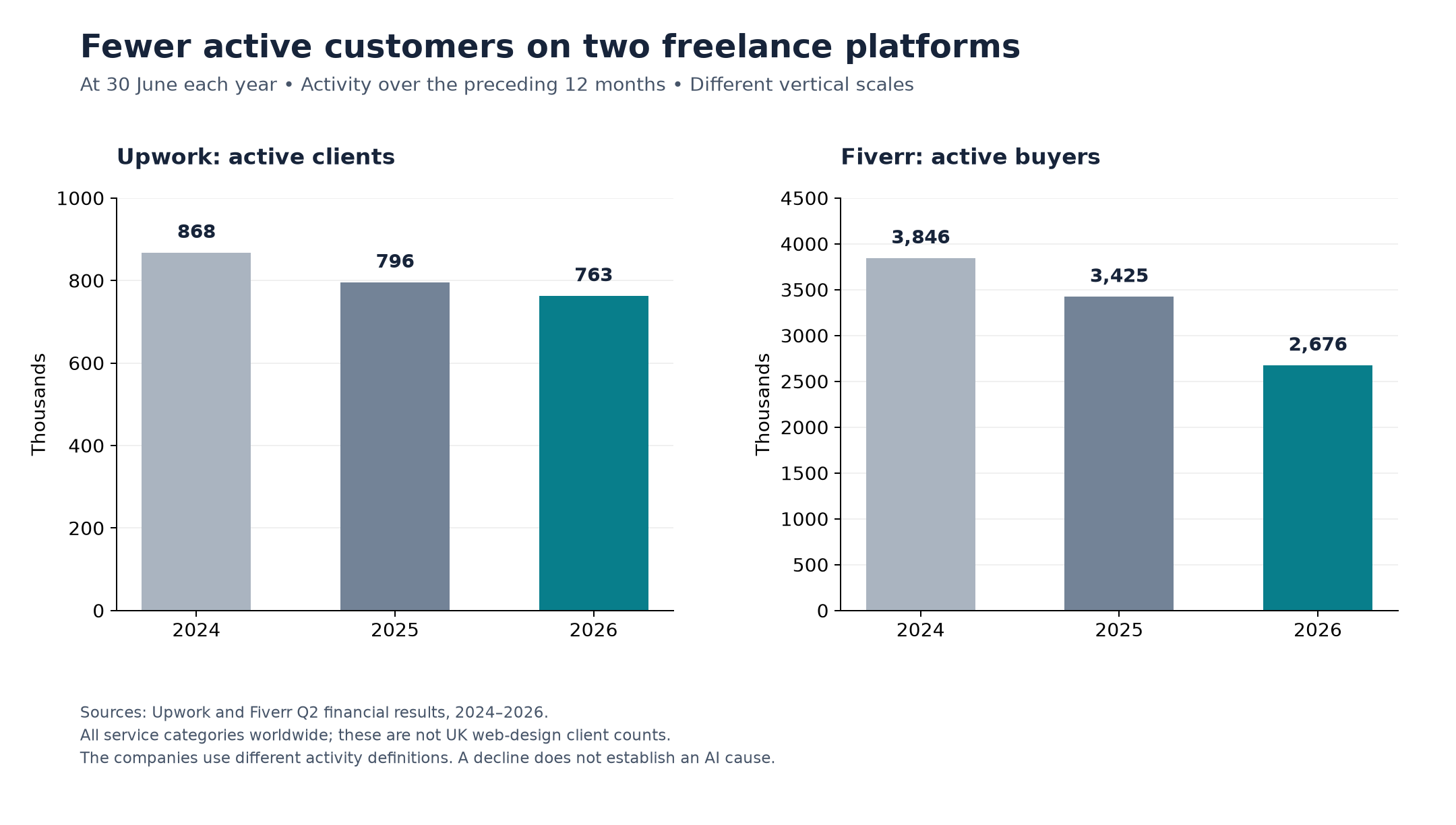
Both platforms report fewer active customers. Their definitions differ, and neither series isolates web design or identifies how much of the change was caused by AI.
There are positive platform signals too. Dribbble reported first-quarter 2026 design and development payment volume up 289% year on year. However, its payment marketplace is relatively young, and changes that bring more work through its systems affect the comparison. Its growth cannot establish that total demand for designers rose by anything like that amount. Dribbble’s marketplace update.
Together, these results justify investigating where work is moving. They do not provide a single global verdict. Designers may lose work because clients spend less, move to another supplier, use a different channel or do more themselves. Those explanations have different implications for the profession.
Who manages UK business websites?
The UK Business Data Survey 2026 offers a closer look at websites. It found that 78% of UK businesses had a website, compared with 68% in its 2023-2024 survey. The newer fieldwork ran from October 2025 to January 2026, so these are not results for the whole of 2026. DSIT’s survey.
Among businesses with a website, 29% described a mixture of internal and external support, 27% managed it entirely in-house, 24% used an external developer or platform, and 17% managed it internally using a platform provider.
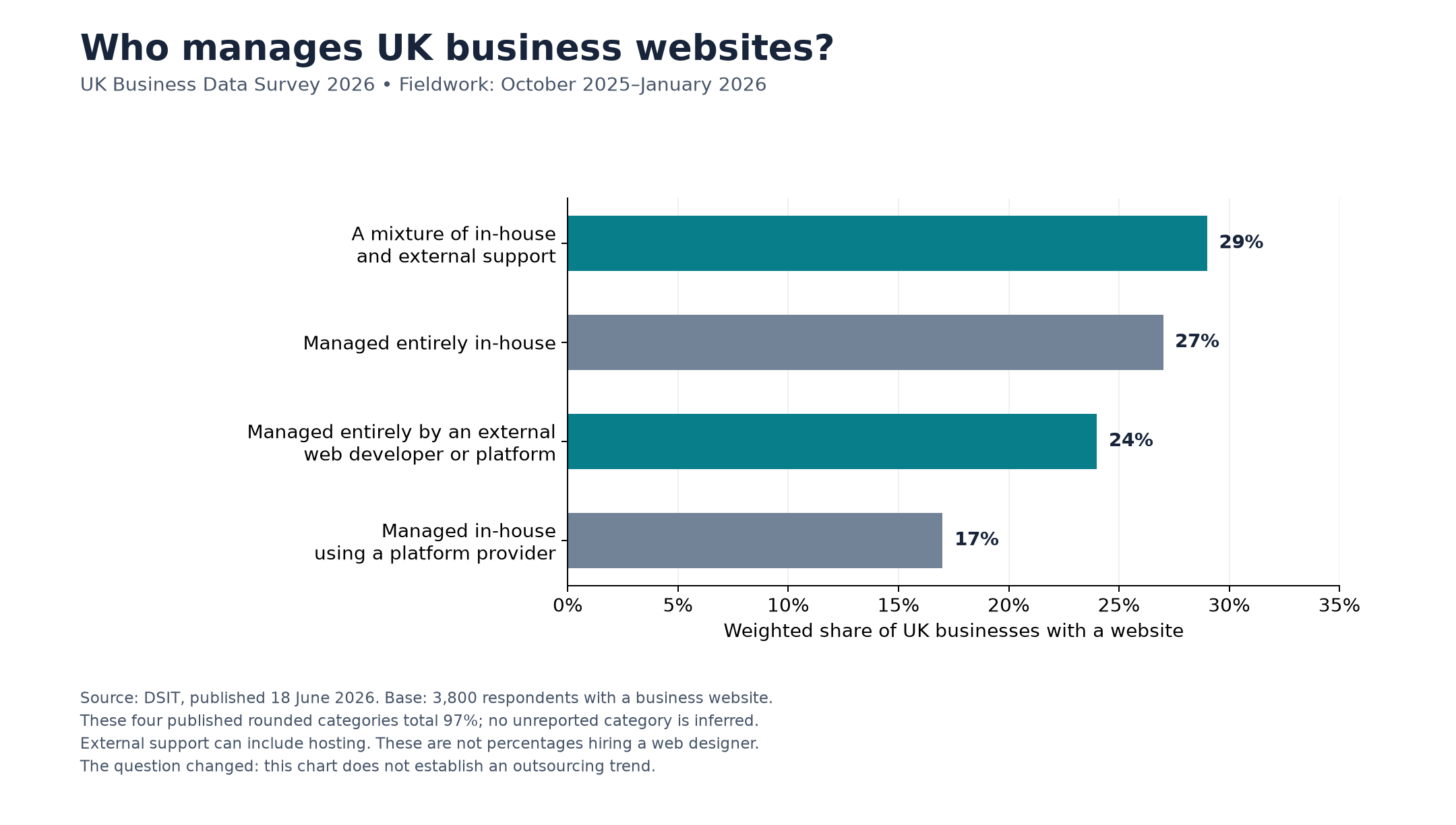
Selected responses from UK businesses with a website. Percentages are rounded and do not sum to 100%. External management includes developers or platforms and may cover hosting. The chart therefore cannot tell us how many businesses paid a designer.
This is a useful challenge to the idea that businesses must choose between using a platform and involving another person. In practice, responsibility can be shared. It also exposes a gap in the debate: having a website tells us little about what its owner spends on design.
We still lack a reliable, comparable figure for the change in paid UK web design projects in 2026. It would be misleading to fill that gap with either worldwide freelance customer counts or the growth of the UK’s entire design economy.
Three different experiences
Spencer Thomas of Brighton’s Podium Design describes a market in which AI has accelerated production without causing the price collapse he had heard predicted. He says more clients approach freelancers because they want direct contact with the person doing the work. He also describes pressure on medium-sized studios. This is a practitioner’s account, published on a website selling his services; he does not provide a representative market sample or independently verified revenue figures. Thomas’s account of the Brighton market.
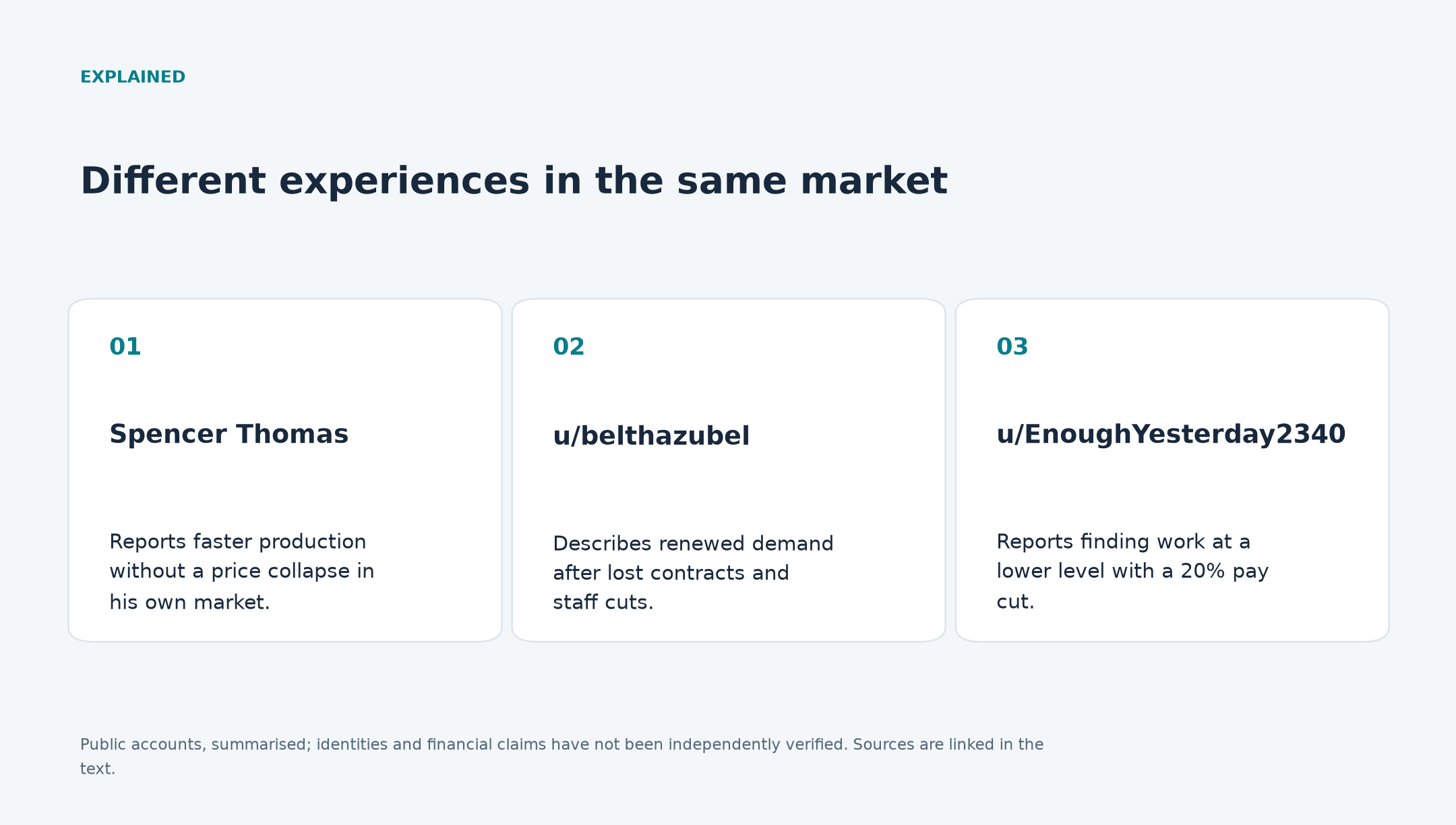
Public accounts, summarised; identities and financial claims have not been independently verified. Sources are linked in the text.
A UK discussion in the neighbouring field of user experience research shows how recovery can feel different to different people. Reddit user u/belthazubel, identifying themselves as a senior user-centred design manager, described losing contracts and staff in 2025, then seeing demand in 2026 that their organisation could no longer cover. Their comment.
In the same discussion, u/EnoughYesterday2340 said they had accepted a lower-level role after a redundancy, starting in January with a 20% pay cut and more work. They also saw more vacancies. Both accounts are anonymous, self-reported and unverified; UX research is a related specialism, not a synonym for web design. Neither establishes that AI caused the job losses. Their comment.
The distinction matters. More hiring can coexist with reduced pay, heavier workloads and experienced people accepting less senior positions. Counting whether someone has found work will miss those changes in the quality of a career.
Who gains from faster work?
AI use is spreading in UK businesses. ONS found that 34.9% of businesses with at least ten employees reported using an AI technology in June 2026, compared with 25.1% a year earlier. Among businesses using AI for visual content, 52.5% reported effects on creative or design roles. An affected role may involve changed tasks; this is not a percentage of designers made redundant. ONS analysis.
Faster production does not decide who gets the value of the time saved.
Editorial takeaway
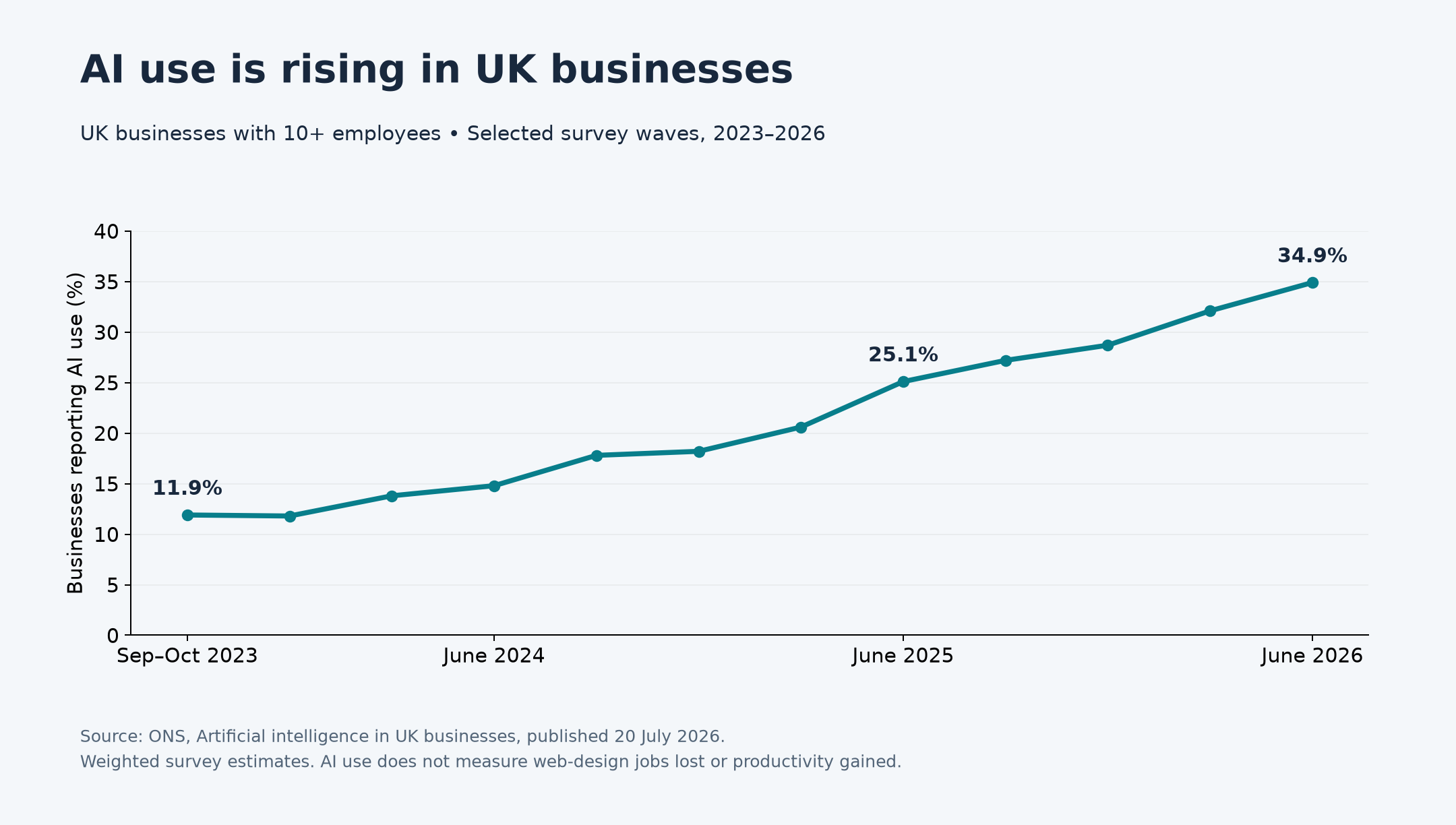
Source: ONS, July 2026. Businesses with 10+ employees; AI use does not measure designer redundancies.
Consider a simplified example. A fixed-fee project taking fewer hours could improve a designer’s effective hourly earnings. But if the client negotiates the fee down, expects more variants or adds rounds of review, some of that saving disappears. The same tool can produce very different financial outcomes depending on the agreement around the work.
For an employee, increased output might mean more ambitious work, a larger workload or a smaller team. For a freelancer, it could mean room for another client, provided another paying client exists. Treating production speed as a direct measure of prosperity leaves out the difficult part: who captures the value of the time saved?
How might the job change?
Producing a straightforward brochure site, designing a distinctive brand experience and improving a complex booking journey involve overlapping skills but different problems. A tool that produces an acceptable first version of one does not settle the economics of all three.
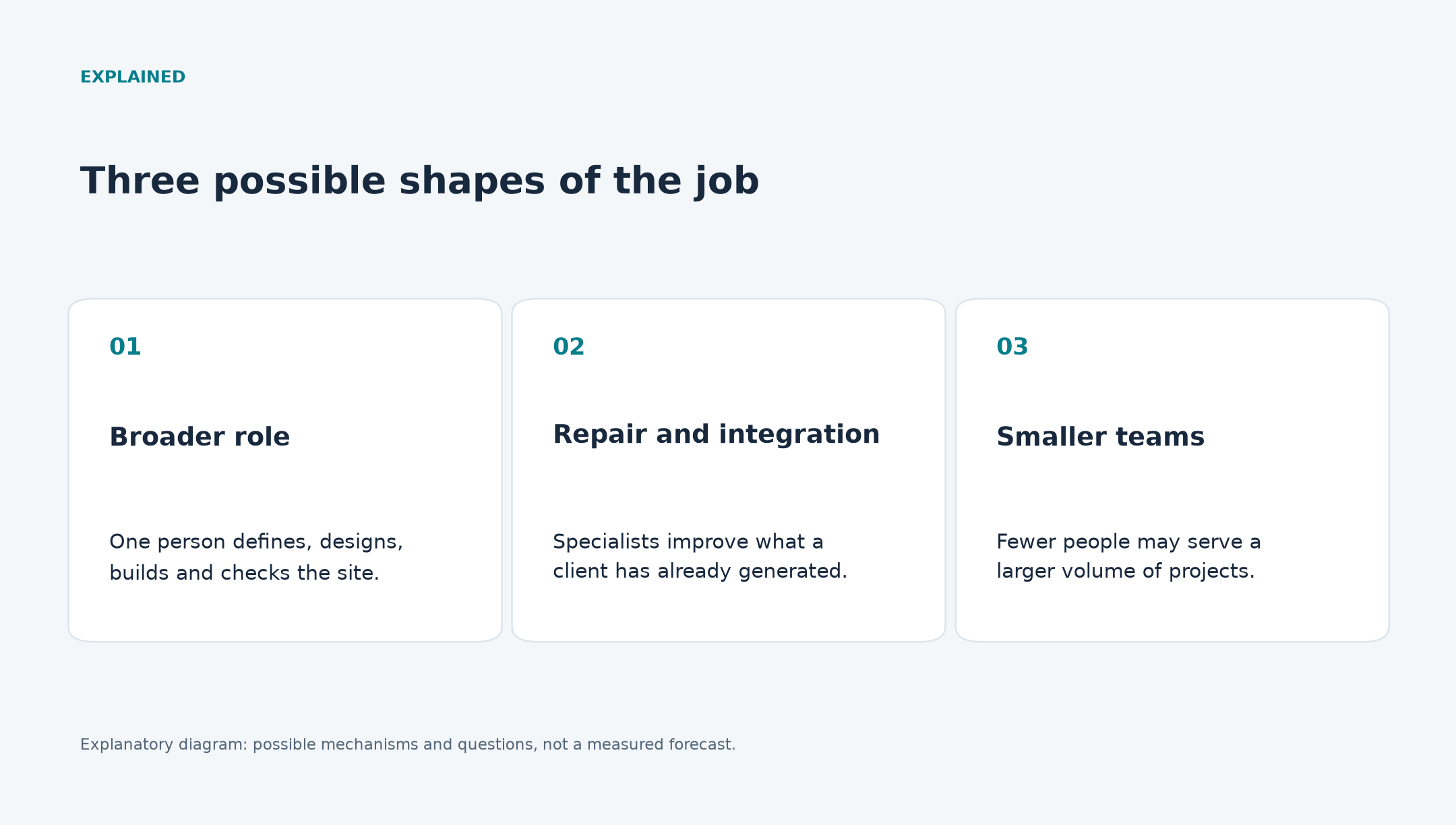
Explanatory diagram: possible mechanisms and questions, not a measured forecast.
One plausible direction is a broader role: the same person helps define the problem, generates alternatives, implements the site and checks how it works. Another is a narrower service built around correcting, connecting and maintaining output that a client has already generated.
A third is fewer design specialists serving a larger volume of projects. These are scenarios to investigate, rather than established descriptions of the whole market.
Each creates a question about entry into the profession. If junior tasks are automated, where will beginners acquire judgement and experience? If a freelancer must cover strategy, design, implementation and testing, what happens to the person who is strong in only part of that work?
Expanding a job description can create opportunity while also raising its demands.
What do the forecasts say?
The US Bureau of Labor Statistics projects 6.0% employment growth for web and digital interface designers between 2025 and 2035. Its corresponding forecasts are 3.8% for web developers and a 1.7% decline for graphic designers, against 3.5% growth across all occupations. These are US projections, released in August 2026, and the categories cover different kinds of work. BLS occupational projections.
A growing profession can still become harder to enter.
Editorial takeaway
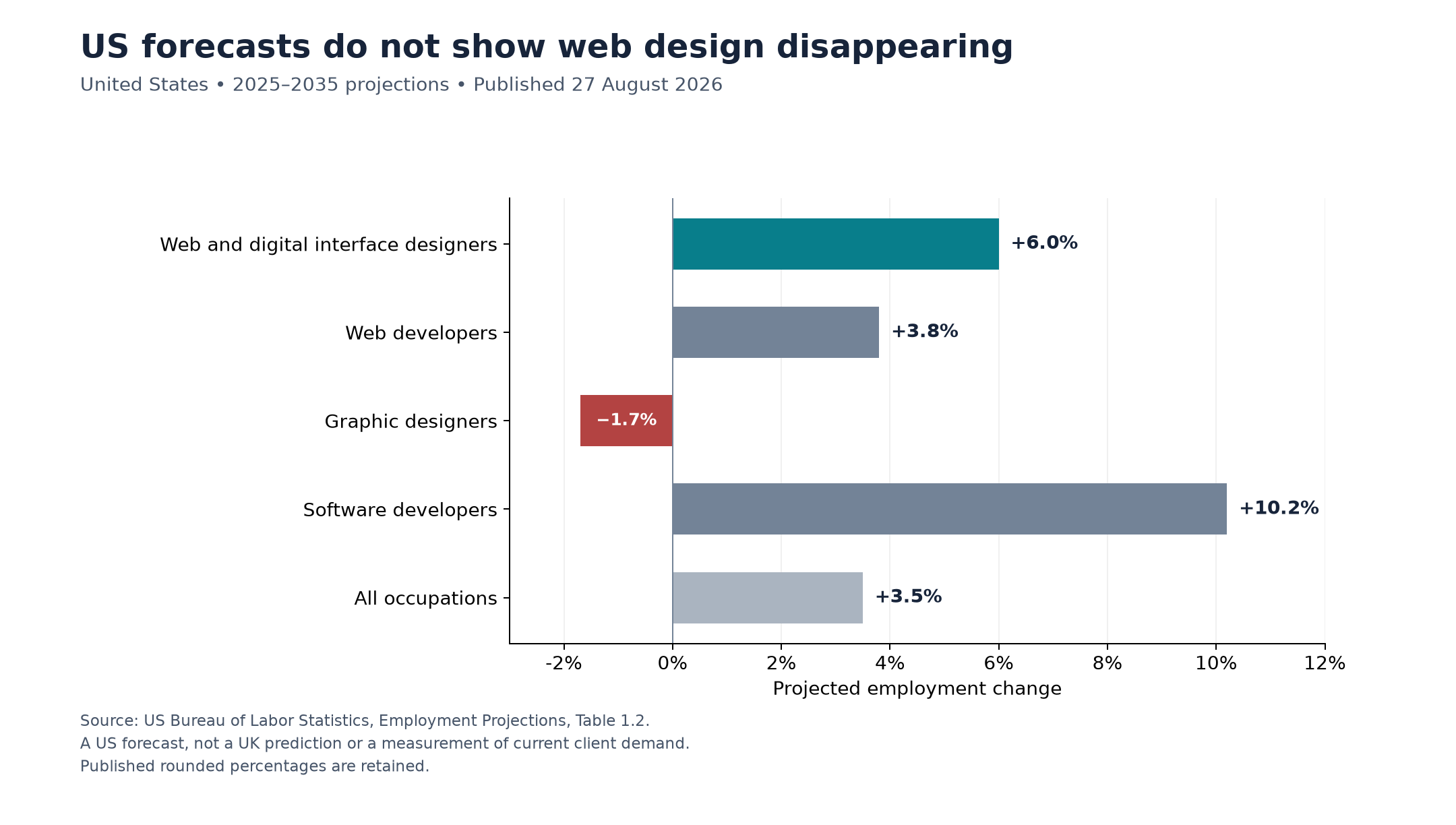
Projected US employment change, 2025-2035. This is a forecast, rather than growth already recorded or an estimate for UK designers.
BLS explicitly considers productivity improvements from design tools, including generative AI. Its forecast therefore allows technological change and overall employment growth to coexist. It still cannot promise work to a particular designer, preserve current business models or tell us what will happen to UK freelance fees. BLS assumptions about occupational change.
What are you seeing in your work?
The evidence reviewed here does not establish that web design is disappearing. It does show why continued demand for websites offers limited reassurance on its own. A profession can persist with fewer entry points, different responsibilities or less attractive working conditions.
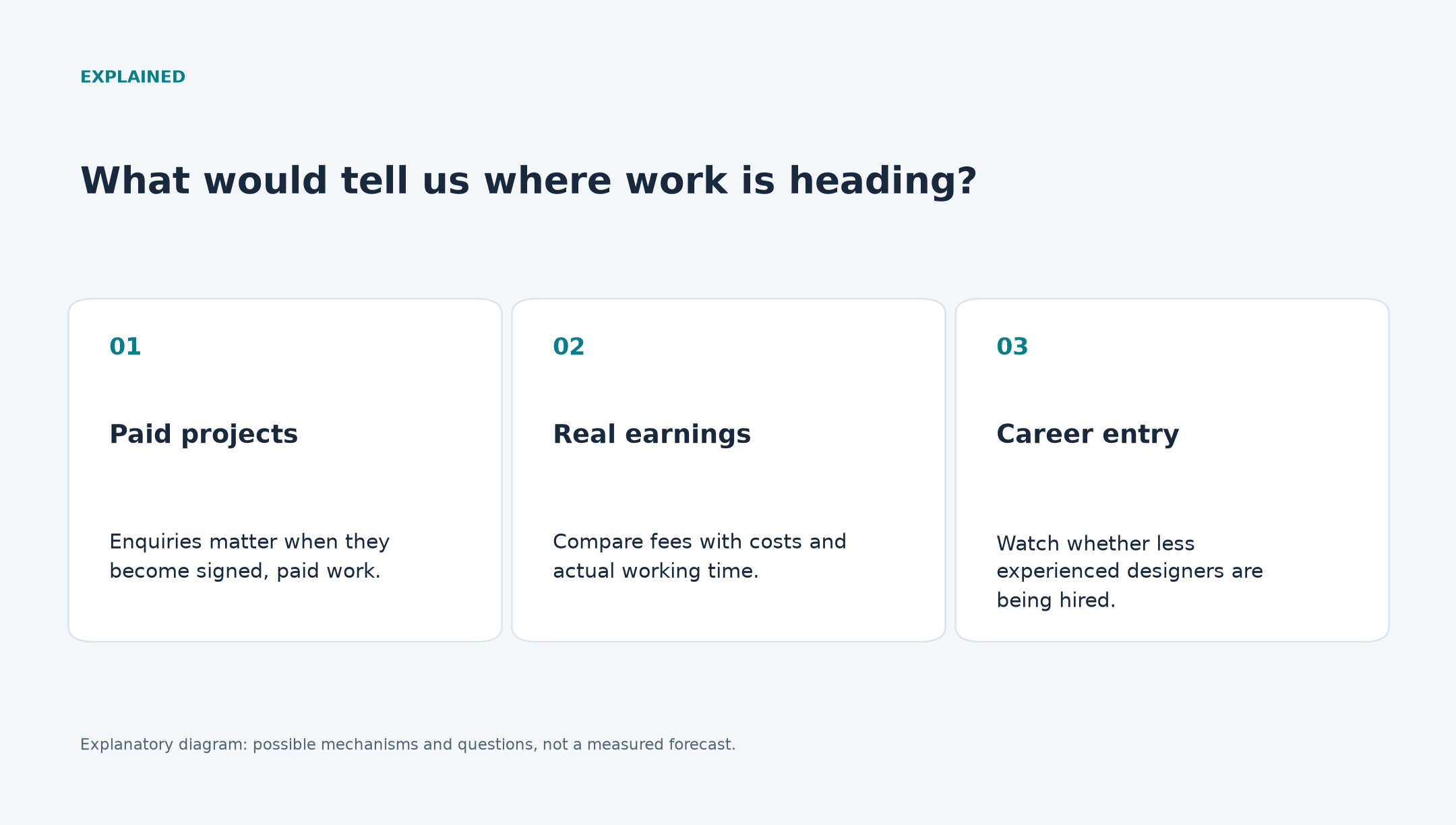
Explanatory diagram: possible mechanisms and questions, not a measured forecast.
To assess what happens next, we need comparable measures of enquiries, signed projects, realised fees, paid working time and staffing. If output rises while fees and employment fall, that would support a contraction scenario.
If new clients and services expand sufficiently to sustain earnings and hiring, it would support a broader transformation. Both should remain open to evidence.
If you work in web design, what has changed for you compared with the same period last year: fewer enquiries, fewer signed projects, smaller budgets, or more work within each project? Has AI increased your take-home income, reduced your hours, or mainly increased expectations? And are newer designers still finding a route in?
Share your country, specialism and whether you work independently or in a team. Contrasting experiences will make this discussion more useful than another confident prediction that everyone is either safe or finished.
Research checked on 7 September 2026. This article combines published statistics with attributed practitioner accounts. UK findings, international platform figures and US forecasts are identified separately; personal accounts illustrate experiences and are not treated as representative surveys.